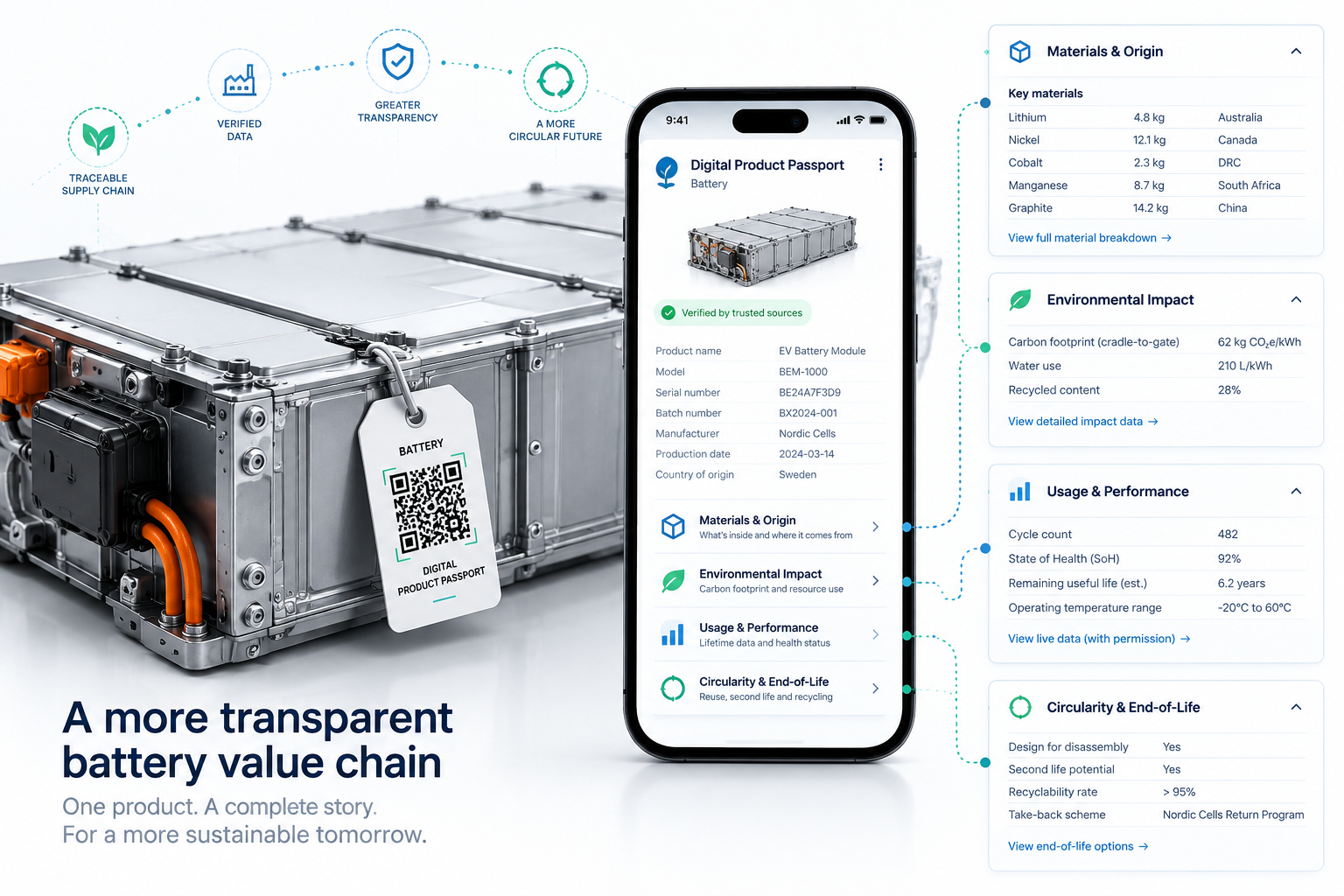
Digital Product Passports for trusted, sovereign product data
InnoTractor helps manufacturers, logistics providers, and asset owners implement Digital Product Passports (DPPs) that make critical product data (material composition, certificates, custody history, and compliance status) available to authorized partners across a product’s entire lifecycle, without relying on a centralized platform or surrendering control over who can see what.
This digital infrastructure supports the controlled, cryptographically verifiable sharing of product data, from battery chemistry and carbon footprint to maintenance records and ownership transfers, with regulators, supply chain partners, and end users, while keeping each product’s data sovereign to the party responsible for it.
Why Digital Product Passports are needed
EU regulation is moving fast: the Battery Regulation (EU 2023/1542), the Ecodesign for Sustainable Products Regulation (ESPR), and sector-specific frameworks increasingly require manufacturers to make verifiable product data available throughout a product’s life, from raw material sourcing to end-of-life recycling.
Today, that data is scattered across supplier systems, spreadsheets, and paper certificates, with no shared standard for how it should be structured, verified, or exchanged. The result is duplicated effort, unverifiable claims, and compliance gaps that surface only during an audit or a recall.
A Digital Product Passport only delivers on its promise when it is built on a trusted data infrastructure: one where custodianship of a product’s data can transfer as the product changes hands, where claims can be cryptographically attested rather than taken on faith, and where access can be granted (and revoked) without exposing the underlying dataspace to a single point of failure. This is precisely where dataspace-based DPP infrastructure adds value.
Case Study: Digital Product Passports for EU Battery Regulation compliance
InnoTractor has designed a DPP registry service for batteries that aligns with the BatteryPass data model (DIN DKE SPEC 99100) and the requirements of the EU Battery Regulation, supporting the full lifecycle of a battery pass from production through second use and recycling.
The design combines cryptographic attestation of key data points with a model for transferring ownership and custodianship as a battery moves between manufacturers, integrators, and operators, so that responsibility for the data always sits with whoever currently holds the product. A hybrid integration model connects this registry to existing dataspace infrastructure (EDC, IDSA/DSP), allowing battery data to be queried and verified without forcing every participant onto a single shared platform.
The result is a compliance model that scales beyond batteries: the same registry pattern (verifiable claims, transferable custodianship, and dataspace-native access control) applies equally to DPPs for other regulated product categories entering the market under ESPR.
By embedding Digital Product Passports within a secure dataspace, organizations can:
Minimize duplicate data entry and manual compliance reporting
Gain real-time visibility into a product's composition, certification status, and custody history as it moves through the supply chain
Shorten audit, recall, and end-of-life processing times, and reduce error rates
Meet regulatory demands around data protection, transparency, and sovereignty
InnoTractor collaborates with manufacturers, logistics partners, and standardization bodies across Europe to build scalable, interoperable DPP infrastructures that support compliant, transparent, and efficient supply chains.
Schedule a demo with one
of our experts.
Global supply chains are becoming increasingly complex and interdependent, increasing the risk of disruption.